
US Domestic Dysprosium/Terbium Supply: Impact of MP Materials' Mid-2026 HREE Commissioning
What MP Materials' mid-2026 HREE commissioning means for SH/UH EV motor magnet sourcing, Dy/Tb risk, 2027-2028 validation, and buyer actions.
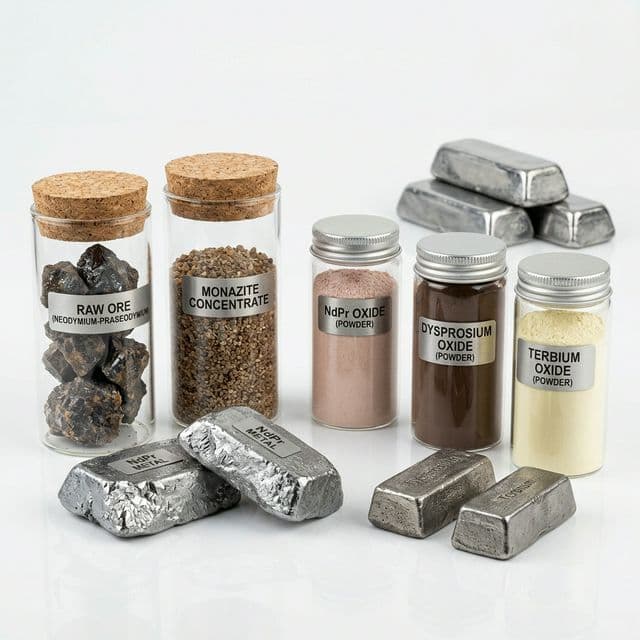
Executive Summary: Why This Matters
Decision-level conclusion: As of July 3, 2026, MP Materials' Q1 2026 release and earnings call indicate that scaled Heavy Rare Earth Elements (HREE) separation commissioning at Mountain Pass is scheduled for mid-2026 / Q2 2026, with terbium and dysprosium production targeted later in 2026. This matters because Dy and Tb are the limiting inputs for SH/UH NdFeB magnets in many Interior Permanent Magnet (IPM) traction motors. EV procurement teams should treat the milestone as a 2027-2028 sourcing-planning event, not as immediate spot-market availability of car-grade magnets.
Scope and boundary: This analysis is for United States, European Union, and global EV or industrial motor teams evaluating SH/UH traction motor rotor magnets, IPM/SPM architecture risk, OEM sourcing strategy, and buyer-facing quality or delivery changes. It is not a commodity price forecast, legal opinion, or confirmation that automotive-qualified magnets from this route are available today.
What Changed: The Mid-2026 HREE Commissioning Milestone
In its Q1 2026 earnings release (May 7, 2026), MP Materials said scaled HREE separation commissioning activities were set to begin imminently at Mountain Pass. In the same earnings-call cycle, management described the heavy rare earth separation circuit as on schedule to begin commissioning in Q2 2026 and to produce terbium and dysprosium later in 2026. Rather than treating SEG+ material only as a stockpiled byproduct, the Mountain Pass route is intended to bring Dy/Tb separation into the domestic midstream circuit.
Public reporting and company-linked commentary have described a target of approximately 200 tonnes per year of separated Dy and Tb. Treat this as a target nameplate planning signal, not bankable 2026 supply: commissioning yield, qualification timing, allocation, and downstream magnet-making capacity still determine how much reaches EV motor programs.
Market Landscape Transition (Last 30 Days Context)
| Supply Chain Phase | Pre-2026 Status | Mid-2026 Milestone (What Changed) | Expected Post-2027 State |
|---|---|---|---|
| Mountain Pass Outputs | Light Rare Earths (NdPr) separated domestically; heavy elements largely outside U.S. commercial separation. | Commissioning window opens for an HREE circuit targeting Dy/Tb separation. | Commercial output could feed domestic metallization, alloy, and magnet facilities if ramp and qualification targets hold. |
| Dy/Tb Availability | Highly concentrated in Chinese separation facilities or Asian intermediaries. | New localized source under commissioning, backed by existing Mountain Pass material streams, reducing dependence on Asian refining if ramp succeeds. | Possible emergence of a "dual-track" market with distinct pricing for localized vs. imported Dy/Tb. |
| OEM Magnet Sourcing | Forced to accept Chinese HREE inputs even for magnets manufactured in the EU or US. | Strategic re-evaluation window opens for 2028 platforms to spec fully localized materials. | Tier-1 motor manufacturers offering parallel quotes based on origin requirements. |
Why It Matters for EV Motor Engineering
To understand why this sourcing shift is critical, we must look at the physics of traction motors. The vast majority of modern EVs use IPM architectures because they offer high power density and extended efficiency ranges.
However, IPM motors expose their rotor magnets to severe demagnetizing fields and high operating temperatures (often reaching 150°C to 200°C). Standard Neodymium magnets lose their magnetic strength (coercivity) rapidly as temperature rises. To prevent catastrophic demagnetization, engineers specify SH (Super High) or UH (Ultra High) grade NdFeB magnets. These grades achieve their thermal resilience primarily through the addition of Dysprosium (Dy) and Terbium (Tb).
Magnet Grade Requirements and GBD Impact
The severity of the operating environment dictates the required Dy/Tb content. As the maximum operating temperature (Tmax) increases, the intrinsic coercivity (HcJ) requirement forces higher heavy rare earth (HREE) concentrations.
| Magnet Grade Suffix | Typical Max Operating Temp (Tmax) | Primary EV Motor Application | Legacy Alloy Dy/Tb % (Weight) | Modern GBD Dy/Tb % (Weight)* |
|---|---|---|---|---|
| SH (Super High) | ~150°C | Standard passenger EV traction motors | 4% - 6% | 1.5% - 2.5% |
| UH (Ultra High) | ~180°C | High-performance / heavy-duty EV motors | 6% - 8% | 2.5% - 4.0% |
| EH (Extra High) | ~200°C | High-speed performance rotors | 8% - 10% | 4.0% - 6.0% |
| AH (Advanced High) | ~230°C | Aerospace, extreme environments | >10% | 6.0%+ |
* Applicability Boundary: Grain Boundary Diffusion (GBD) technology concentrates HREEs only at grain boundaries, reducing total heavy rare earth content by 50–70% while maintaining thermal stability. A domestic 200t/year capacity goes significantly further when paired with advanced GBD manufacturing.
Without Dy and Tb, many high-performance EV traction motors as currently designed cannot hold coercivity margin at hotspot temperature. MP Materials' commissioning window means that the most vulnerable node in the EV motor bill of materials, heavy rare earth separation, now has a credible Western planning path. For the grade-selection side of the decision, pair this supply review with the SH vs UH magnet grades guide and the Grain Boundary Diffusion guide.
Domestic HREE Value Chain for SH/UH Magnets
The progression from SEG+ stockpile to automotive-validated traction motor magnets.
Impact on Buyers, Specifiers, and Importers
For sourcing teams, a domestic Dy/Tb route changes negotiation leverage and risk mitigation strategies even before full output reaches mass production. Previously, buyers had to absorb geopolitical risk premiums because there was limited alternative to the dominant Chinese separation chain. Now, OEMs can actively structure "dual-origin" sourcing paths and ask suppliers to price localized HREE content separately from imported HREE content.
Sourcing Path Comparison
| Sourcing Path | Material Origin | Supply Chain Stability | ESG & DPP Readiness | Expected Cost Profile |
|---|---|---|---|---|
| Fully Localized (China) | 100% Chinese | High (Mature), but high geopolitical risk | Low (Hard to trace origin reliably) | Baseline (Lowest upfront) |
| Hybrid (China Refined) | Mixed origin, Chinese refined, US/EU machined | Medium | Medium (Traceability gaps remain at separation level) | Moderate Premium |
| North American Closed-Loop | MP Materials (mine and separation) to U.S. magnet factory | Potentially high after ramp, but execution-sensitive | High if chain-of-custody records survive alloy, sintering, machining, and coating | Premium (offset only where credits, strategic value, or customer requirements justify it) |
Risks, Constraints, and Timeline boundaries
[!WARNING] Do not expect immediate availability of finished car-grade magnets. Commissioning a chemical separation plant is not the same as shipping an automotive-validated product.
Sourcing teams must be acutely aware of the following constraints:
- The Validation Time-Lag: MP Materials is discussing commissioning and production of separated oxides. These oxides must be converted to metal alloys, sintered into NdFeB blocks, machined, coated, and then subjected to rigorous automotive validation (IATF 16949 / PPAP). This downstream process typically takes 12 to 18 months before mass production (SOP) is feasible.
- Nameplate vs. Yield: A 200t/year nameplate capacity does not guarantee 200t of immediate yield. Ramp-up curves for rare earth separation are historically steep and challenging.
- Allocation Prioritization: Given the strategic nature of Dy and Tb, early production volumes are highly likely to be allocated to strategic partners (e.g., General Motors, DoD contracts) rather than the spot market.
- Evidence Gap - GBD Technology Scale: Modern high-efficiency motors rely on Grain Boundary Diffusion (GBD) to minimize the absolute amount of Dy/Tb used. Western capacity for GBD at scale is still developing, which remains an unverified downstream bottleneck.
Procurement Risk Matrix: HREE Transitions
| Risk Category | Trigger Condition | Business Impact | Buyer Mitigation Strategy |
|---|---|---|---|
| Validation Delay | Domestic metallization misses PPAP target dates. | 2028 platforms delayed or forced back to single-source Asian supply. | Secure backup allocation with established tier-1s; do not single-source initially. |
| Yield Shortfall | Initial extraction yield falls below 200t/yr nameplate. | Spot market prices surge; allocations limited to top strategic partners. | Establish direct off-take agreements upstream early; monitor Q3/Q4 2026 yield. |
| GBD Bottleneck | Western factories lack scaled GBD capacity. | Forced to use legacy high-Dy alloys, rapidly exhausting domestic supply. | Audit Tier-1 suppliers specifically for domestic GBD capital expenditure. |
| Price Premium | Domestic supply costs substantially exceed imported NdFeB. | Margin compression on EV powertrains. | Leverage IRA (Inflation Reduction Act) credits and DPP compliance value to offset costs. |
Who Should Act Now: Buyer Checklist
To capitalize on this milestone, OEM purchasing managers and motor engineers should immediately execute the following steps for programs launching in late 2027 and beyond:
- Audit Current Dy/Tb Exposure: Calculate the total mass of Dy and Tb required per vehicle platform. Understand your exact vulnerability to export quotas or price shocks.
- Demand Dual Quotes: Instruct Tier-1 motor suppliers to provide parallel quotes for 2028 platforms: one based on traditional Asian supply, and one based on localized MP Materials (or similar) feedstock.
- Review GBD Readiness: Ensure your engineering teams are aggressively pursuing Grain Boundary Diffusion (GBD) technology to lower the absolute requirement of HREEs, extending the reach of limited domestic supply.
- Engage Upstream Directly: Do not wait for Tier-1s to solve the problem. Engage directly with emerging US and EU magnet manufacturers (like MP's own downstream facilities, Vacuumschmelze, or e-VAC) to secure future allocation slots.
Sourcing Risk Timeline: Bridging the Gap to Domestic SOP
Strategic purchasing windows relative to the MP Materials commissioning timeline.
FAQ
Does MP Materials' 200t/year target capacity cover the entire EV market?
No. Global demand for Dy and Tb far exceeds 200 tonnes. This target capacity acts as a strategic beachhead, with reach depending on the exact grade, magnet mass per vehicle, and GBD usage, but it will not single-handedly replace Chinese supply. It enables a "de-risked" premium supply chain for critical platforms.
Can we buy SH/UH magnets directly from Mountain Pass today?
Not yet. The public milestone is about chemical separation of rare earth oxides. Those oxides must go through downstream metallization, alloying, sintering, machining, coating, and PPAP/IATF validation to become finished automotive magnets. MP is building downstream magnet capacity in Texas, but fully validated car-grade magnets from this exact supply chain will take time to reach mass production.
Why not just use Light Rare Earths (NdPr) and avoid Dy/Tb entirely?
Without Dy/Tb, NdFeB magnets rapidly lose coercivity at high temperatures. While some motor designs (like externally excited synchronous motors or induction motors) avoid magnets entirely, the power density and efficiency of the widely used Interior Permanent Magnet (IPM) motor currently rely heavily on the thermal stability provided by Dy and Tb.
Will localized Dy/Tb be more expensive?
In the near term, yes. The spot market for Chinese Dy/Tb is heavily subsidized and scaled. North American supply carries a premium due to higher labor, environmental compliance, and start-up capital costs. However, buyers should weigh this premium against the cost of abrupt export controls or supply chain disruptions.
Which internal decisions should this change first?
Change sourcing governance before changing rotor design. Add Dy/Tb origin, GBD readiness, and PPAP timing gates to the EV motor magnet RFQ checklist, then use the sample-to-mass-production handoff checklist to prevent a sourcing milestone from being mistaken for an automotive release.
Sources
- MP Materials Corp. (2026). Q1 2026 Financial Results and Corporate Update. (May 7, 2026). MP Materials investor release - Primary source for imminent scaled HREE separation commissioning at Mountain Pass.
- MP Materials Corp. (2026). Q1 FY2026 earnings call transcript. (May 7, 2026). Yahoo Finance / Quartr transcript - Management commentary that the heavy rare earth circuit remained on schedule to begin commissioning in Q2 and produce Tb/Dy later in 2026.
- MP Materials Corp. (2025). Form 10-K for fiscal year 2025. MP Materials SEC filing PDF - Describes HREE facility scope, 2026 expected commissioning, and initial focus on terbium and dysprosium products.
- U.S. Department of Energy (DOE). Critical Materials Assessment and supply chain materials. energy.gov - Baseline context for NdFeB dependence and the strategic necessity of domestic heavy rare earth separation.
- Industry Benchmarks / Applied Magnetics. NdFeB Grade Classifications and Thermal Stability Limits. - Verifies common SH/UH/EH/AH operating-temperature classes and the role of GBD in HREE reduction.
Need OEM support?
Email [email protected] with your drawing package, quantity stages, and target timeline.