
1 Phase to 3 Phase Back EMF Converter & Validation Report
Tool first: convert one measured back-EMF channel into balanced three-phase equivalents with explicit assumptions. Then verify trust boundaries, data sources, and method tradeoffs before you commit controller constants.
Published: April 6, 2026 | Last evidence update: April 6, 2026 (stage1b research-enhance)
Evidence review cadence: Quarterly evidence review (next scheduled review: July 6, 2026)
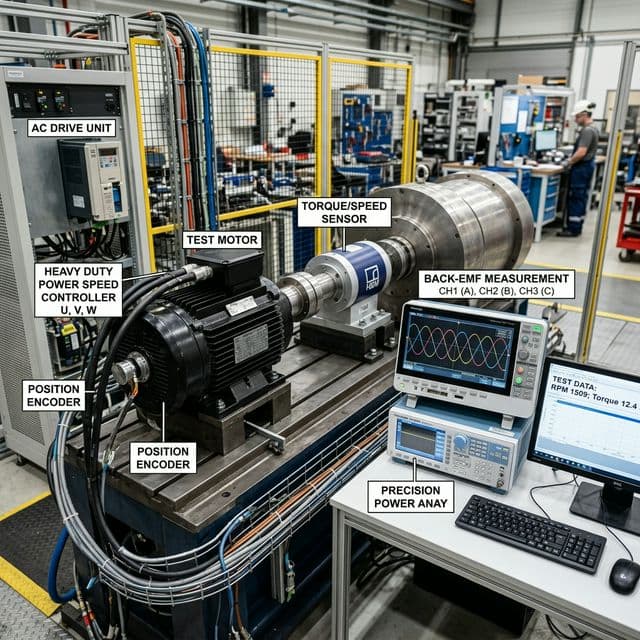
Enter assumptions and run the converter. Result will include equivalent 3-phase metrics plus confidence score.
Report summary: decision-focused conclusions
The tool output is paired with boundary-aware guidance so teams can decide whether to proceed, re-measure, or escalate.
Under balanced assumptions, line-line RMS is phase RMS times sqrt(3). Source tags: S1, S2.
Default equivalent: 36.0V LL from 20.8V phase.
THD inflates total RMS versus fundamental. Fundamental-equivalent path is required when THD is non-trivial. IEEE 519 scope is PCC-level, so this page THD boundary is screening-only. Source tags: S7, S11.
Default fundamental estimate: 35.9V LL.
Electrical frequency should align with speed and pole pairs. Mismatch usually indicates metadata or capture issues. At very low speed, back-EMF observability can be insufficient for closed-loop inference. Source tags: S6, S8, S9.
Default: 120.0Hz electrical.
Sequential capture and unbalance jointly dominate conversion reliability. NEMA/DOE evidence sets a stricter review posture once unbalance exceeds 1%, and current asymmetry can expand to about 6-10x voltage unbalance. Source tags: S3, S4, S10.
Escalate to simultaneous channels when score < 80.
| Condition | Use decision | Reason |
|---|---|---|
| 3-phase machine, known pole pairs, unbalance ≤ 1%, and synchronized capture | Use | Assumptions stay close to balanced conversion model. |
| Unbalance 1-2% or dual-channel capture | Use with review | Keep as provisional estimate; rerun with synchronized channels. |
| Native single-phase machine or unknown winding context | No use | 1-phase-to-3-phase inference is not physically grounded. |
| THD > 12% with no fundamental extraction | No use | Total RMS alone can misstate inferred three-phase constants. Threshold is screening heuristic, not compliance. |
| Startup-dominant low-speed data with weak BEMF SNR | No use | Sensorless back-EMF observability may be insufficient for reliable conversion. |
Method, equations, and evidence chain
The conversion path and evidence are separated and auditable. Any uncertain point is labeled instead of assumed.
| Gap found | What was changed | Status |
|---|---|---|
| THD and confidence thresholds were presented without evidence-level separation. | Separated evidence-backed boundaries from internal heuristics and added explicit disclosure near results. | Closed in stage1b |
| Voltage-unbalance boundary was under-specified for decision-critical use. | Aligned review boundary to >1% with NEMA/DOE evidence and added escalation guidance. | Closed in stage1b |
| Low-speed and startup observability limits were not explicit enough. | Added cross-vendor low-speed caveats (TI/Microchip/NXP) and risk-trigger path. | Closed in stage1b |
| Filtering-delay tradeoff lacked quantified example. | Added AN1083 delay-budget example and timing-risk row in logic table. | Closed in stage1b |
| Evidence gaps were not explicitly marked for users. | Added pending-confirmation table with no-reliable-public-data labeling. | Closed in stage1b |
| Step | Equation | Notes |
|---|---|---|
| Reference normalization | phaseRMS = lineLineRMS / sqrt(3) (for line-line input) | Valid only under balanced 3-phase interpretation. Source tags: S1, S2. |
| Forward conversion | lineLineRMS = phaseRMS x sqrt(3) | Keep line-line vs phase labels in every output row. |
| Fundamental estimate | V1 ≈ Vtotal / sqrt(1 + THD²) | Use when measured RMS includes harmonic content. THD thresholds here are screening heuristics. Source tags: S7, S11. |
| Voltage unbalance check | %VU = max deviation from average / average * 100 | DOE/NEMA boundary logic for review and escalation. Source tags: S3, S4. |
| Frequency sanity check | f_elec = (rpm / 60) x polePairs | Flags metadata errors before constants are reused in control files. Source tags: S6, S8, S9. |
| Timing delay risk check | t_commutation = t_zero-cross + delay_budget | Filter and processing delay must be compensated for timing-sensitive interpretation. Source tags: S5, S7. |
| Constant conversion | Ke_phase = VphaseRMS / krpm, Ke_LL = VllRMS / krpm | Report both constants with unit convention and reference. |
| Decision dimension | Evidence-backed boundary | Tool heuristic | Action impact |
|---|---|---|---|
| Voltage unbalance at motor terminals | NEMA states best performance at <=1% phase-voltage unbalance; DOE documents the unbalance formula and 6-10x current-unbalance amplification. | Review starts at >1%; high-risk escalation starts at >2% or when decisions are release-critical. | Escalate to synchronized 3-phase capture before freezing constants. Source tags: S3, S4 |
| Low-speed back-EMF observability | Microchip and NXP app notes state that very low speed / startup conditions can make back-EMF sensing unreliable or unavailable. | Treat low-speed and startup-dominant captures as provisional even if arithmetic conversion succeeds. | Use open-loop startup data only for trend, then re-capture at stable speed. Source tags: S6, S8, S9 |
| Filtering delay in timing workflows | AN1083 gives an explicit delay-compensation example (90 us LPF + 1.7 us processing) for correct commutation timing. | Filtering without documented delay budget triggers review-required or insufficient verdict. | Record filter group delay and compensate in post-processing or control firmware. Source tags: S7 |
| THD interpretation scope | IEEE 519 scope applies harmonic limits at PCC; this does not directly define a universal pass/fail value for one-channel bench conversion. | THD >12% is used here as screening-only heuristic, never as compliance proof. | Do not present this page THD output as IEEE-519 certification. Source tags: S11 |
| Phase/line-line constant conversion | For balanced three-phase interpretation, phase and line-line constants differ by sqrt(3) and must keep RMS/peak conventions explicit. | Always publish both phase and line-line Ke with reference labels. | Prevents cross-team unit mismatch in controls and procurement handoff. Source tags: S1, S2, S10 |
| ID | Source | Key data | Context | Date |
|---|---|---|---|---|
| S1 | Kollmorgen white paper: Servo system design and parameter conversion | No single industry standard exists for servo units; for wye windings, line-line voltage constants map to line-neutral by sqrt(3), and RMS/peak conventions must not be mixed. | Defines conversion guardrails and unit-boundary risk for this page. | Oct 2015 white paper, accessed April 6, 2026 |
| S2 | MathWorks PMSM documentation | Back-EMF constant is defined per phase; the documented per-phase voltage for wye is line-to-neutral and may differ from line-line declarations. | Supports per-phase interpretation before line-line reporting. | R2026a documentation, accessed April 6, 2026 |
| S3 | NEMA MG-1 Part 12 (polyphase motor operation) | NEMA notes that best motor performance is when phase voltage unbalance does not exceed 1%. | Evidence-backed boundary for when single-channel conversion should be reviewed. | MG-1 Part 12 watermark PDF, accessed April 6, 2026 |
| S4 | U.S. DOE Motor Systems Tip Sheet #7 | Voltage-unbalance method uses max deviation from average; current unbalance can be 6-10x voltage unbalance, with measurable efficiency and temperature effects. | Adds a quantitative risk signal for unbalance-driven conversion error. | DOE publication (updated host copy), accessed April 6, 2026 |
| S5 | Texas Instruments SPRABQ7A (sensorless BLDC control) | Six-step control commutates about 30 electrical degrees after zero crossing, while low speed is more sensitive to noise around the crossing point. | Supports timing-risk disclosure and low-speed caution for decision use. | Jul 2013, rev Sep 2015, accessed April 6, 2026 |
| S6 | Microchip AN1160 (sensorless BLDC with back-EMF filtering) | BEMF magnitude is proportional to speed, electrical frequency equals mechanical speed times pole-pair count, and low speed can make BEMF sensing infeasible. | Primary evidence for frequency sanity check and low-speed boundary. | AN1160 Rev D (2008-2022), accessed April 6, 2026 |
| S7 | Microchip AN1083 (sensorless BLDC with back-EMF filtering) | At low speed, shallow BEMF slope increases false crossing risk; at high speed, filter delay must be compensated (example delay budget includes 90 us LPF + 1.7 us processing). | Evidence for delay-compensation and filtering tradeoff section. | 2007 app note, accessed April 6, 2026 |
| S8 | NXP AN1914 (3-phase BLDC sensorless back-EMF zero-cross) | Back-EMF sensing requires two conditions: measured phase not being driven and no current in measured winding; sensing is valid only in specific intervals. | Supports explicit scope limits for one-channel inference. | Rev 1.0, Nov 2005, accessed April 6, 2026 |
| S9 | NXP AN2355 (sensorless 3-phase BLDC with back-EMF detection) | Back-EMF cannot be reliably sensed at very low speed, so startup uses an open-loop sequence before closed-loop estimation. | Cross-vendor confirmation of low-speed limits and startup caveat. | Rev 4.0, Jan 2019, accessed April 6, 2026 |
| S10 | Tektronix primer: 3-phase motor-drive oscilloscope measurements | Accurate 3-phase work requires deskew and phase-angle alignment; line-line and line-neutral values need explicit conversion factors. | Supports synchronized-channel and probe-deskew requirements. | Tektronix primer, accessed April 6, 2026 |
| S11 | IEEE 519-2022 scope statement | Harmonic distortion limits are defined at the user point of common coupling (PCC), not at every internal motor-terminal test node. | Clarifies that this page THD boundary is a screening heuristic, not IEEE-519 compliance. | IEEE standards page, crawled 2026; accessed April 6, 2026 |
| Question | Status | Decision impact | Minimum follow-up |
|---|---|---|---|
| Universal THD cutoff for 1-channel to 3-phase back-EMF conversion | No reliable public standard found | THD 12%/18% values on this page are screening defaults, not universal acceptance limits. | Use machine-family test plans or OEM requirements for release gates. |
| Industry-standard confidence-score formula for this workflow | No reliable public formula found | The confidence score is a transparent heuristic index, not a standards-based certification score. | Pair this score with synchronized capture evidence before final decisions. |
| Cross-vendor Ke unit declaration consistency | Partially specified, often vendor-specific | Different datasheets mix RMS/peak and phase/line conventions, causing silent conversion errors. | Require unit declaration in every handoff artifact and supplier data review. |
Comparison: measurement and decision pathways
Choosing capture method matters as much as conversion formula. Comparison is structured for reproducible decisions.
| Topology | What you get | Main risk | Best use |
|---|---|---|---|
| Single-channel sequential | Lowest hardware burden, basic trend visibility | Phase/time skew; weak cross-phase comparability | Early bench screening only |
| Dual-channel synchronized | Moderate confidence for pairwise mapping | Still partial observability of all three phases | Pre-commit controls review |
| Three-channel simultaneous + deskew | Highest phase integrity and repeatability | Higher setup complexity and instrumentation effort | Release-critical constants and validation packages |
| Path | Lead time | Decision confidence | Recommended trigger |
|---|---|---|---|
| Use converter only | Fastest | Medium (depends on quality score) | Feasibility triage with non-critical outcomes |
| Converter + synchronized re-measure | Moderate | High | Controls constant freeze or procurement shortlist |
| Converter + dyno/FEA closure | Longest | Highest | Safety margin, compliance, or customer acceptance sign-off |
Risks, boundaries, and mitigation playbook
Risks are concrete and paired with minimum executable mitigation, not listed as generic warnings.
| Trigger | Impact | Minimum action |
|---|---|---|
| THD above 12% | Fundamental component can be overstated if total RMS is treated as sinusoidal fundamental. | Use fundamental estimate path and re-measure with bandwidth/aliasing checks (screening heuristic, not compliance threshold). Source tags: S7, S11 |
| Voltage unbalance above 1% | Phase asymmetry quickly amplifies current and thermal risk; balanced-conversion assumptions become fragile. | Escalate to synchronized 3-phase capture and compute per-phase constants separately before release decisions. Source tags: S3, S4 |
| Single-channel sequential capture only | Phase-angle uncertainty and timing skew can misclassify line-line/phase mapping. | Upgrade to dual or three-channel synchronized measurement before final decision. Source tags: S10 |
| Very low speed / startup-dominant data | Back-EMF signal can be too small or interval-limited for reliable inference. | Treat output as provisional; rerun at stable speed where BEMF observability is validated. Source tags: S6, S8, S9 |
| Unknown pole-pair count | Electrical frequency check becomes invalid; speed-derived interpretation drifts. | Confirm pole count from motor teardown, datasheet, or validated electrical-cycle count. Source tags: S6, S8 |
| Filtering added without delay compensation | Back-EMF timing landmarks shift, causing incorrect inferred constants under dynamic tests. | Document filter phase delay and compensate in post-processing or measurement pipeline. Source tags: S5, S7 |
| Scenario | Assumptions | Outcome |
|---|---|---|
| Bench spin test (good capture) | 36 Vrms line-line @ 1800 rpm, 4 pole pairs, THD 4%, unbalance 1%, dual-channel synchronized | High-confidence conversion. Equivalent phase RMS is stable and Ke spread is small enough for shortlist decisions. |
| Sequential handheld capture | 36 Vrms line-line @ 1800 rpm, THD 10%, unbalance 2.8%, single-channel sequential capture | Review-required. Conversion usable for rough screening only; re-capture with simultaneous channels before controller constants are frozen. |
| Noisy inverter coast-down data | 33 Vrms phase-neutral equivalent, THD 18%, unbalance 5.5%, trapezoidal waveform assumption | Insufficient confidence. Tool returns minimum continuation path: isolate measurement chain, reduce distortion, then rerun. |
FAQ and conversion path
Questions are grouped by decision intent so users can move from estimate to action without guesswork.
1105 brushless motor N52SH arc magnets checker
5 phase dual axial flux permanent magnet generator checker
10 kW axial flux generator checker
EV motor magnet manufacturers qualification guide
GM truck cooling fan CFM hybrid checker
12 pole magnets 9 coil stator hybrid checker
89mm arc magnets neodymium checker and risk report
17yearold designed electric motor rareearth magnets hybrid checker
Contact engineering for benchmark interpretation
Scope discussion for engineering support