
Hub Motor Checker: 46 Magnets Hub Motor Fit, Risks, and Decision Path
This canonical page answers both hub motor and 46 magnets hub motor intent. Run the checker first for an actionable result, then use the report layer to validate method, evidence, and risk boundaries.
Published: April 17, 2026 | Evidence updated: April 17, 2026 (stage1b research refresh)
Quick starts
Start with the 46-magnet baseline, then change one variable at a time so you can attribute risk changes to a specific assumption.
Typical Br: 1.37-1.42 T. Common SH-grade baseline for traction hubs; keep thermal margin explicit for summer duty.
Report summary: key conclusions and key numbers
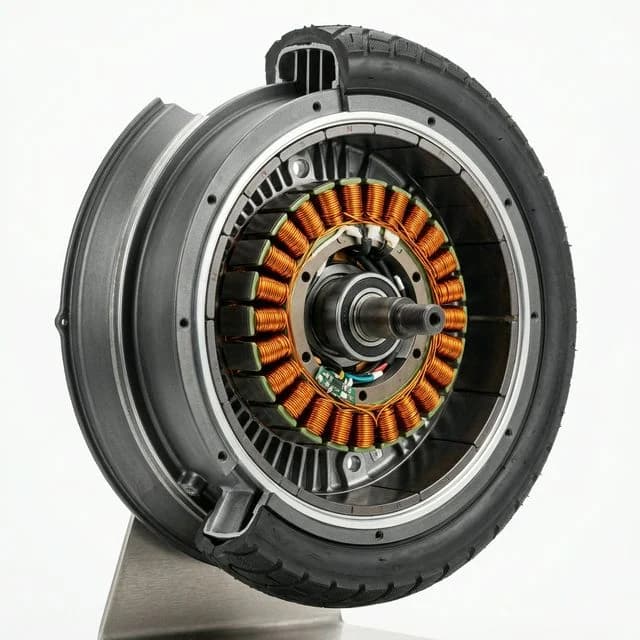
For a 46-magnet hub motor, the electrical frequency rises quickly with wheel rpm, so control strategy and inverter headroom become first-order decisions.
Fractional-slot concentrated winding zones can be valid, but low-q combinations increase sensitivity to cogging, ripple, and acoustic variation.
When electrical frequency climbs, six-step commutation ripple becomes harder to ignore and FOC often becomes the practical path.
If modeled hotspot approaches grade limits, result confidence drops and the minimum path is thermal test plus lot-level B-H confirmation.
| Audience | Suitable? | Why | Not suitable when |
|---|---|---|---|
| Urban commuter e-bike platform | Suitable with validation | 46-pole hubs commonly align with low-to-mid speed requirements when controller and thermal path are matched. | Unknown winding quality or uncontrolled thermal duty. |
| Cargo and delivery continuous duty | Conditional | Works when current and hotspot are controlled with robust cooling and conservative continuous rating. | Natural-air only cooling under high ambient with aggressive current targets. |
| High-speed wheel concepts | Conditional to risky | Feasible only when inverter bandwidth, sensing, and mechanical retention are engineered together. | Six-step strategy with strict NVH/efficiency constraints above high electrical-frequency zones. |
| Retrofit with unknown teardown data | Not suitable yet | Screening can guide what to measure first. | Decision is frozen before confirming pole/slot/grade/thermal facts. |
| Area | Gap found | Impact | Repair | Severity |
|---|---|---|---|---|
| Evidence hierarchy | Core claims mixed standards, vendor pages, and secondary explanations without evidence ranking. | Decision confidence was uneven and hard to audit in technical design reviews. | Refreshed core evidence with UN R85, USGS 2026, IEA 2026, and EU CRMA, then kept vendor data as scoped examples only. | high |
| Boundary precision | Continuous-vs-peak discussion and commutation geometry lacked explicit numeric test conditions. | Teams could overstate continuous capability or miss controller commissioning limits. | Added R85 test basis (30-minute average, conditioning, power hold) and Hall electrical-mechanical angle boundary examples. | high |
| Comparison with counterexamples | Option comparison listed pros/cons but not explicit falsification triggers. | Users could not quickly identify when 46 magnets should be rejected. | Added decision-dimension matrix with counterexamples, trigger conditions, and minimum validation actions. | medium |
| Unknown-data disclosure | No explicit statement on missing public datasets for magnet-count distribution by power class. | Anecdotal teardown numbers could be misread as global design rules. | Added explicit unknown marker: "No reliable public dataset yet (暂无可靠公开数据)" with minimum path to verify internally. | medium |
Deep layer: method and evidence
1. Normalize assumptions
Use even magnet count, declared slot count, phase count, target max wheel rpm, and ambient/cooling context.
2. Compute electromagnetic pacing
Derive pole pairs, q-value, electrical frequency, and commutation cadence for the selected control mode.
3. Estimate thermal and load indicators
Estimate torque constant, continuous torque potential, radial-load index, and hotspot margin versus chosen grade.
4. Map to action bands
Convert indicators into fit/caution/high-risk bands with explicit uncertainty and minimum next action.
5. Screen concentration and compliance exposure
Check sourcing concentration and policy thresholds before locking BOM assumptions for production programs.
| Boundary | Valid when | Fails when | Minimum action | Source |
|---|---|---|---|---|
| Magnet count parity | Even magnet count; checker range 20-80. | Odd count or outside range. | Correct pole count first, then rerun. | R2 |
| Slot-pole-phase q window | q roughly 0.2-0.55 for this stage-1 screen. | q below 0.2 or above 0.55 without special design intent. | Re-evaluate slot/pole pairing and winding strategy. | R1, R11 |
| Commutation pacing | Electrical frequency and cadence remain within controller bandwidth. | High electrical frequency with six-step mode under strict NVH targets. | Switch to FOC or lower target rpm before geometry freeze. | R2, R3 |
| Hall sensor geometry mapping | Mechanical Hall placement is converted from electrical angle using actual pole count. | Electrical-angle assumptions are reused without recalculating mechanical placement. | Recalculate commissioning geometry before releasing Hall sensor fixture and calibration plan. | R3 |
| Thermal confidence | Estimated thermal margin >= 15 C. | Margin below 15 C or hotspot estimate uncertain. | Run thermal test + lot-level magnetic curve confirmation. | R4, R5 |
| Power-basis consistency | Inputs and targets are locked to one declared continuous/rated basis. | Peak-only marketing values are mixed into continuous screening. | Convert all benchmark points to a continuous basis (or explicitly stay in peak basis) before comparison. | R6, R7 |
| Supply concentration and compliance exposure | Single-country dependence and sourcing plan are explicitly checked against policy and business limits. | Program assumes stable supply with no diversification path despite concentrated value-chain signals. | Run sourcing stress test and define dual-source or fallback-grade path before SOP freeze. | R8, R9, R10 |
| ID | Source | Key data | Decision use | Date / scope |
|---|---|---|---|---|
| R1 | Emetor glossary: slots per pole per phase | Defines q = S / (P × m) and clarifies fractional-slot concentrated winding context. | Used for q-value definition in this checker; treated as a secondary explainer, not a formal standard. | Accessed April 17, 2026 |
| R2 | Microchip BLDC six-step documentation | Six-step uses 6 sectors per electrical cycle, 60 electrical degrees each, and Np electrical cycles per one mechanical revolution. | Used for cadence model and control-mode guidance at high electrical frequency. | Accessed April 17, 2026 |
| R3 | TI SLVAEG3 hall commutation brief | For a 12-pole example, 120 electrical degree Hall separation maps to about +/-20 mechanical degrees. | Used to explain why pole count and controller phasing cannot be separated in commissioning. | Published 2023, accessed April 17, 2026 |
| R4 | NASA/TM-20230010737 electric machine winding guidance | Round-conductor slot fill is commonly around 35%-55% for first-pass assumptions; 40% is suggested as conservative initial estimate. | Used for manufacturability and thermal-risk boundary when slot fill assumptions are optimistic. | September 2023, accessed April 17, 2026 |
| R5 | Arnold magnetic materials catalog (vendor data) | Public grade tables list NdFeB/SmCo remanence and temperature-class tradeoffs; values are catalog-level and not a universal standard. | Used as indicative grade-screening reference only; final limits still need supplier lot data. | Catalog accessed April 17, 2026 |
| R6 | UN Regulation No. 85 (UNECE official text) | Defines maximum 30 minutes power as the average over 30 minutes; requires defined conditioning and controlled power band for test. | Used to lock power-basis interpretation and avoid peak-vs-continuous mixing in design screening. | Revision 1 text (2013), accessed April 17, 2026 |
| R7 | EMRAX 228 datasheet v1.6 | Publishes peak (S2, 2 min) and continuous (S1) ratings side by side in one product sheet. | Used as practical evidence for keeping peak and continuous basis separate in checker input. | Version 1.6 March 2025, accessed April 17, 2026 |
| R8 | USGS Mineral Commodity Summaries 2026: Rare Earths | U.S. net import reliance is listed as 67% in 2025; China share of U.S. imports is listed as 71% (2021-2024). | Used for sourcing-risk and concentration-risk framing in procurement decisions. | February 2026 |
| R9 | IEA Rare Earth Elements executive summary | For 2024, China share is stated as 60% in mining, 91% in refining, and 94% in permanent-magnet production. | Used for concentration-risk and diversification urgency in long-term platform planning. | 2026 report, accessed April 17, 2026 |
| R10 | European Commission Critical Raw Materials Act page | States 2030 benchmarks: extraction >=10%, processing >=40%, recycling >=25%, and <=65% from one third country. | Used to set compliance-aware sourcing boundaries for EU-facing programs. | CRMA adopted in 2024, accessed April 17, 2026 |
| R11 | LUT academic work on fractional-slot PM synchronous machines | Documents that q < 1 concentrated winding configurations can increase harmonic, cogging, and torque-ripple sensitivity. | Used to justify treating low-q combinations as validation-heavy instead of auto-accepting by rule of thumb. | Academic publication, accessed April 17, 2026 |
| Topic | New fact with explicit time | Decision impact | Source |
|---|---|---|---|
| Six-step commutation cadence | Six-step uses 6 sectors at 60 electrical degrees each, and electrical cycles scale with pole-pair count. | A 46-pole motor (23 pole pairs) reaches high electrical cadence quickly, so controller strategy becomes an early architecture constraint. | R2 |
| Hall geometry conversion | TI shows that in a 12-pole case, 120 electrical degrees maps to about +/-20 mechanical degrees. | Pole-count changes require re-commissioning Hall geometry; reusing old fixtures increases startup and commutation risk. | R3 |
| Continuous rating basis | UN R85 defines maximum 30-minute power as a 30-minute average under specified conditions. | Prevents peak-only claims from being treated as continuous capability in thermal sizing and supplier selection. | R6, R7 |
| Slot-fill realism | NASA TM cites 35%-55% round-conductor slot fill with 40% as a conservative first estimate. | Overstating slot fill inflates torque expectation and can hide hotspot risk during early screening. | R4 |
| Rare-earth supply concentration | USGS reports 67% U.S. net import reliance (2025), while IEA reports 2024 concentration at 60% mining, 91% refining, and 94% magnets in China. | Single-source assumptions create cost and availability risk for long-life programs. | R8, R9 |
| Policy boundary for diversification | EU CRMA 2030 benchmarks include <=65% dependence on one third country plus extraction/processing/recycling targets. | Programs serving EU markets need sourcing plans aligned to policy-driven diversification expectations. | R10 |
Comparison and alternatives
| Dimension | 46-magnet baseline signal | Counterexample / limitation | Minimum action | Source |
|---|---|---|---|---|
| Electrical pacing at top speed | 46 poles => 23 pole pairs; at 650 rpm the checker basis is about 249 Hz electrical. | Lower-pole options (for example 40 poles) can materially reduce electrical frequency at the same wheel speed. | Decide topology with controller bandwidth and NVH targets in the same design review. | R2 |
| Commutation commissioning | Hall placement must be converted from electrical to mechanical angle using actual pole count. | A Hall fixture that works on one pole count can miscommutate after pole-count changes. | Recompute Hall geometry and re-run startup/ripple validation after any pole-count change. | R3 |
| Continuous torque and power claims | R85 and product datasheets distinguish continuous (S1/rated) from short-duration peak (S2). | Using peak numbers as continuous inputs can make a high-risk architecture look acceptable. | Lock one rating basis in requirements and reject mixed-basis supplier comparisons. | R6, R7 |
| Winding-risk sensitivity (q and harmonics) | q-value is useful for screening, and low-q concentrated winding can raise ripple sensitivity. | q alone does not predict final torque ripple without geometry-specific simulation and tests. | Treat low-q outcomes as validation-heavy, not as automatic fail/pass. | R1, R11 |
| Sourcing resilience and policy fit | USGS/IEA signal concentrated rare-earth supply; EU CRMA adds diversification benchmarks. | A cost-optimal single-source BOM may fail resilience or compliance expectations in later gates. | Add dual-source/fallback-grade plan before SOP and before long-term price negotiation. | R8, R9, R10 |
| Option | Strengths | Tradeoffs | Use when |
|---|---|---|---|
| 46 magnets hub motor (direct drive baseline) | Smooth low-speed torque potential, strong regen behavior, compact BOM variants. | Electrical frequency can rise quickly at speed, and magnet retention/thermal path must be controlled. | Urban e-bike, scooter, or light EV hubs with clear thermal model and FOC-ready controller. |
| 40-magnet hub architecture | Lower electrical frequency at same rpm, easier controller bandwidth headroom. | Can reduce torque smoothness or change winding constraints depending on slot pairing. | Programs constrained by inverter switching budget or high-speed wheel targets. |
| 48-magnet hub architecture | Higher magnetic event density can help low-speed feel and startup response. | Higher electrical pacing pressure and stronger sensitivity to commutation strategy. | Low-speed heavy-load duty with robust controller and validated thermal margin. |
| Mid-drive IPM/PMSM alternative | Can reduce unsprung mass and move thermal load away from wheel hub. | Introduces drivetrain complexity, gearbox losses, and packaging differences. | When suspension dynamics or high-continuous power density dominates architecture choice. |
Directional estimate for screening only; not a release-level guarantee.
Below 15 C enters caution gate in this workflow.
High or low extremes increase retention and ripple risk.
Risk controls and boundaries
Magnet delamination under repeated thermal cycling
Impact: Air-gap damage, torque ripple growth, and potential catastrophic rotor contact in severe cases.
Mitigation: Validate adhesive system at duty-cycle temperature profile and run mechanical overspeed margin tests.
Controller mismatch at high electrical frequency
Impact: Commutation loss, acoustic noise, and lower efficiency near top-speed band.
Mitigation: Run controller-inverter co-validation with electrical-frequency target from checker output.
Over-optimistic slot fill assumptions
Impact: Copper loss and hotspot rise exceed expectation, invalidating nominal torque plan.
Mitigation: Use process-realistic fill assumptions and verify with winding-process capability data.
Peak-vs-continuous basis confusion
Impact: Design appears feasible on paper but fails continuous thermal validation.
Mitigation: Freeze one declared power basis before architecture comparison and supplier shortlisting.
Rare-earth supply concentration shock
Impact: Lead-time and price volatility can invalidate launch timing and margin assumptions.
Mitigation: Use dual-source/fallback-grade planning and contract clauses linked to concentration-risk events.
Policy-misaligned sourcing for EU-facing programs
Impact: Late-stage compliance and customer acceptance risk if diversification expectations are ignored.
Mitigation: Run a CRMA-aware sourcing check before RFQ closure and before long-term nomination.
| Topic | Status | Decision impact | Minimum executable path |
|---|---|---|---|
| Global mapping of hub-motor power class vs magnet count | No reliable public dataset yet (暂无可靠公开数据). | High impact on benchmarking and teardown-based assumptions. | Build an internal benchmark dataset from verified teardown and dyno-linked records before setting hard rules. |
| Lot-level irreversible demag curves at actual hotspot | Public catalog values are not enough for final confidence. | High impact on overload and abuse-case durability. | Request supplier lot data + run elevated-temperature demag verification. |
| Rotor retention margin at overspeed | Depends on adhesive, sleeve, and manufacturing process details. | High safety and reliability impact. | Mechanical FEA + burst/overspeed test before SOP freeze. |
| Real road thermal boundary for enclosed hubs | Vehicle airflow and riding profile create high variance. | Medium-high impact on continuous torque promise. | Instrumented road cycle + thermal calibration loop. |
| Long-term supply volatility exposure | Depends on contract terms and regional sourcing footprint. | Medium impact on cost and lead-time resilience. | Dual-source plan with grade fallback and inventory trigger policy. |
Scenario examples
Assumptions: 3-phase, 42 slots, FOC control, natural-air cooling, moderate ambient conditions.
Expected outcome: Usually lands in fit/caution boundary depending on current target and thermal margin.
Assumptions: Higher current, lower rpm, elevated ambient, long duty period.
Expected outcome: Thermal margin often becomes the dominant risk trigger even when q-value looks acceptable.
Assumptions: Near 1000 rpm wheel speed and high bus voltage target.
Expected outcome: Electrical frequency and controller pacing become first-order constraints.
Assumptions: Missing confirmed slot count, grade, and hotspot behavior.
Expected outcome: Output should be treated as directional only; minimum path is teardown + measurement.
Related internal routes
Use when your first question is exact pole-count range for 750 W commuter-class hub design.
Use for the 46-magnet decision case when you need geared eRPM boundaries and direct next-step actions.
Use when slot-pole commutation questions dominate design iteration.
Use for mid-drive/IPM alternatives and higher-speed architecture tradeoffs.
Use when your hub-motor decision needs cross-topology comparison before committing architecture and sourcing strategy.
Use when topology migration beyond radial hub architecture is under review.
FAQ for decision intent
blocker
0
high
0
medium
2
low
1